
Consistency, not perfection, is what transforms exercise into lasting results. You may feel highly motivated when you begin a new workout program, but motivation naturally fluctuates. Busy schedules, slow progress, stress, fatigue, and unrealistic expectations can eventually make it difficult to stick to your routine. Learning how to stay consistent with exercise requires more than willpower. You need clear goals, supportive habits, a realistic schedule, and strategies that help you continue even when you don’t feel motivated. Whether you want to lose weight, build muscle, improve endurance, support your health, or simply become more active, the following 12 practical tips can help you stick to a workout routine and make exercise a sustainable part of your lifestyle.
How Do You Stay Consistent With Exercise?
To stay consistent with exercise, choose activities you enjoy, set realistic goals, schedule your workouts, and start with an amount of exercise you can maintain. Attach your workout to an existing habit, prepare for common obstacles, track your progress, and create a shorter backup workout for busy or low-energy days. Most importantly, focus on returning to your routine rather than trying to follow it perfectly.
Key Takeaways
- Exercise consistency depends more on sustainable systems than temporary motivation.
- Scheduling workouts makes exercise a concrete commitment instead of a vague intention.
- Starting small reduces resistance and helps you develop confidence and momentum.
- Planning for obstacles prevents one difficult day from derailing your routine.
- Making exercise part of your identity supports lasting behavior change.
- Missing a workout does not ruin your progress—returning to your routine is what matters.
Why Is Consistency Important in Exercise?
A consistent exercise routine allows your body and mind to adapt gradually. Individual workouts matter, but the greatest benefits come from repeatedly exposing your body to appropriate physical challenges and giving it time to recover. Regular exercise supports:
As you know, establishing and maintaining a consistent exercise routine is crucial. Here are some reasons why consistency is important in exercise:
- Progression: Staying consistent with your exercise routine allows for gradual progression. Over time, you can increase the intensity, duration, or frequency of your workouts. This progression is essential for continued improvement in fitness levels.
- Adaptation: Your body adapts to the demands you place on it. Regular exercise helps your body become more efficient in performing specific activities, whether it’s running, lifting weights, or participating in a sport.
- Habit Formation: Repeating exercise in a stable context helps it become more automatic over time. As movement becomes part of your normal routine, you rely less on momentary motivation to get started.
- Weight Management: Regular physical activity plays a crucial role in weight management. Consistent exercise, along with a balanced diet and proper stress management techniques, can help you achieve and maintain a healthy weight.
- Mental Health: Exercise has positive effects on mental health, including reducing stress, anxiety, and depression. Consistent exercise can contribute to overall well-being by promoting better mental health.
- Disease Prevention: Regular physical activity is associated with a lower risk of various chronic diseases, including heart disease, diabetes, and certain types of cancer. Consistent exercise contributes to overall health and can be a preventive measure against these conditions.
- Improved Sleep: Working out regularly contributes to better sleep quality. However, consistency is key, as the sleep benefits of exercise may take some time to become noticeable.
- Increased Energy Levels: While it may seem counterintuitive, regular exercise can boost energy levels. Consistent physical activity improves cardiovascular health and enhances the efficiency of the body’s energy systems.
How to Stay Consistent with Exercise
The following are some concrete tips to help you stick to a workout routine:
1. Make a Realistic Commitment
To set yourself up for success, commitment is key. Being truly committed means showing up even when you’re tired, busy, or just not in the mood, especially when it’s inconvenient or uncomfortable.
Start by committing to 30 days of consistent exercise. Aim for either three one-hour sessions a week or five 30-minute sessions – keep in mind the physical activity guidelines. Sticking with it for a full month helps build the habit and makes it easier to continue. As you move forward, remember to follow physical activity guidelines to keep your body strong, energized, and in optimal health.
2. Set Meaningful and Achievable Goals
Set both short-term and long-term goals, that are realistic and meaningful. Anchor each goal to something deeply important to you—something that motivates and inspires you to take consistent action. Then, take time to write out why you want to achieve that goal. Include your current pain points, your driving motivations, and the positive impact reaching that goal will have on your life and those around you.
Be sure to define your goals using the S.M.A.R.T. criteria: Specific, Measurable, Achievable, Relevant, and Time-bound. For example, rather than simply saying, “I want to exercise more,” commit to a goal like: “I will exercise 3 times a week for 45 minutes over the next 90 days to help lower my blood pressure and boost my energy so I can enjoy more active time with my kids.” This framework is concrete and measurable, helping you stick to a workout routine.
3. Start Small and Create a Minimum Workout
One of the biggest mistakes people make is starting with a routine that is too demanding to maintain. You do not need to exercise intensely every day to build consistency. Begin with a schedule that fits your current fitness level, responsibilities, and available time. You can gradually increase the frequency, duration, or intensity as the habit becomes established.
It also helps to create a “minimum workout” for busy or low-energy days. This could be a 10-minute walk, one short strength-training circuit, or a brief mobility routine. Your minimum workout keeps the habit alive without requiring you to perform at your best every time. Something manageable is often better than skipping movement altogether.
4. Attach Exercise to an Existing Habit
Link your workout to a behavior you already engage in regularly and set up visible reminders. For example, if you want to start exercising after work, place your gym bag on the passenger seat. That way, as soon as you get in the car, it signals you to head to the gym or park before going home. Linking behaviors allows you to stick to a workout routine and achieve your goals.
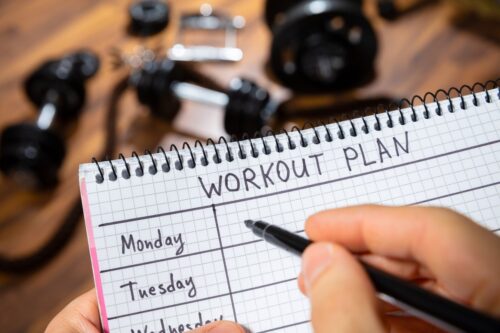
5. Schedule Your Workouts
Treat your workouts like any other important appointment—because they are. You’ve probably heard the phrase, “What gets scheduled, gets done,” and it’s true. It’s one thing to say you want to exercise more, but turning that intention into action takes planning.
When you actually block off time in your calendar or planner for a workout, it becomes a real commitment. This holds you accountable and helps you stick to a workout routine. More importantly, it sends a clear message: your health is a priority.
Be strategic and realistic when setting your workout time. If you’re aiming for early morning sessions, ask yourself if waking up earlier fits your lifestyle. If you’re not a morning person, don’t force it—schedule a time that truly works for you. Then, build a routine around that. Consistency starts with a plan that’s practical and sustainable.
6. Prepare Your Environment and Set Reminders
It’s easy to overlook things that aren’t yet habits or part of your daily routine. To make exercise more consistent and automatic, try setting reminders so it doesn’t slip your mind. Jot down your workout and the time on a sticky note and place it somewhere visible, like your mirror, computer, fridge, desk, or car dashboard. You can also use technology to help you stick to a workout routine by setting alerts on your phone, calendar, or smart assistant.
7. Address Negative Thinking and Excuses
Many times, we can be our worst enemies and allow our minds to sabotage our plans, goals, and even relationships. Having negative scripts running in your head makes you less likely to be able to remain consistent and follow through with your goals. Learn how to Identify Unhelpful Negative Thinking and Stop Self-Sabotage.
8. Plan for Obstacles
When you plan for obstacles, you are more likely to stick to a workout routine. Identify the situations most likely to disrupt your exercise routine and decide in advance how you will respond. This strategy turns vague intentions into specific plans.
For example:
- If an evening commitment interferes with your workout, then you will exercise in the morning or during lunch.
- If the weather prevents an outdoor workout, then you will complete a short indoor routine.
- If you are short on time, then you will do your minimum workout.
- If you miss a scheduled session, then you will return to your routine at the next available opportunity.
Planning for predictable obstacles makes it less likely that a temporary disruption will become a permanent setback.

9. Make Exercise Part of Your Identity
Sustainable behavior change becomes easier when exercise reflects how you see yourself and becomes part of your identity. Instead of thinking, “I’m trying to work out,” begin reinforcing the belief, “I am someone who takes care of my body and moves regularly.”
Every completed workout becomes evidence supporting that identity, even when the session is short or imperfect. Over time, exercise stops feeling like something you occasionally force yourself to do and becomes part of who you are and how you live.
Make an identity shift by changing your mindset and believing that exercise is a non-negotiable part of your weekly routine. You’re not someone who occasionally works out; you’re someone who exercises. Remember, we become what we consistently do.
10. Create Accountability and Track Your Progress
Accountability can make it easier to follow through when your motivation is low. A coach, workout partner, supportive friend, or structured fitness community can provide encouragement, feedback, and an added reason to honor your commitments.
Track your workouts using a calendar, journal, wearable device, or fitness app. You can record:
- Workouts completed
- Exercise duration
- Weight or resistance used
- Repetitions or distance
- Energy and mood
- Strength, endurance, or mobility improvements
Tracking allows you to see progress that may not yet be visible in the mirror. It also helps you identify patterns, celebrate small wins, and adjust your routine when necessary. For instance, the FITNALL App is a tool that gives you a personalized structure, tracks your progress, gives you daily guidance, and keeps you accountable so you can stick to a workout routine.
11. Choose Exercise You Enjoy
When you pick activities you actually enjoy, you’re much more likely to stick with them long term. Find creative ways to make your workouts fun and even sneak in extra movement throughout your day without it feeling like a chore.
Keep things fresh by switching up your routine with a mix of different exercises. When you associate movement with positive, rewarding experiences, it stops feeling like a task and becomes something you look forward to. That’s how consistency sticks.
12. Listen to Your Body and Be Patient
Paying attention to your body during exercise is key to staying safe and getting the most out of your workout. Tune in to how you feel, and don’t hesitate to adjust your routine to prevent burnout or injury. Rest when needed, and remember that progress comes from consistency, not pushing through pain.
You need to be patient with yourself when you are looking to stick to a workout routine. If you are not following the plan 100%, understand that establishing a new habit can take time. Simultaneously, be patient with the process. Many times, people presume that results will take place right away, but that expectation is unrealistic.
Conclusion: How to Make Exercise a Lasting Habit
Learning how to stay consistent with exercise is not about maintaining perfect motivation or completing every planned workout. It is about building a realistic system that helps you continue through busy periods, setbacks, and changes in your energy or schedule. Choose activities you enjoy, schedule your workouts, start with manageable goals, and prepare a shorter backup option for difficult days. Track your progress, seek accountability, and remember that one missed workout does not erase your results. What matters most is returning to the routine. Exercise becomes sustainable when it supports your life instead of overwhelming it. Each time you show up, you strengthen more than your body; you reinforce the identity, habits, and mindset that make long-term health possible.
Need help turning healthy intentions into consistent action? The FITNALL App combines personalized fitness, nutrition, mindset, and lifestyle guidance to help you build a routine that fits your goals and your life.
Frequently Asked Questions
Exercise can be difficult to maintain when your plan requires too much time, energy, or motivation. Unrealistic goals, an inconvenient schedule, lack of enjoyment, slow results, and all-or-nothing thinking can also interfere with consistency. A routine is more sustainable when it is realistic, flexible, enjoyable, and connected to a meaningful goal.
The best frequency is one you can maintain. A beginner may start with two or three planned workouts per week and gradually increase activity over time. Your ideal schedule depends on your fitness level, goals, health, exercise intensity, and ability to recover.
There is no universal timeline. Exercise may begin to feel more familiar within several weeks, but developing a stable, automatic routine can take much longer. Consistency, a predictable schedule, and repeating the behavior in a similar context can help strengthen the habit.
Reduce the size of the task instead of abandoning it. Complete your minimum workout, remind yourself why the goal matters, and focus on starting rather than having a perfect session. Scheduling, accountability, and environmental cues can help you continue without relying entirely on motivation.
Missing one workout will not ruin your progress. Avoid treating it as a failure or trying to compensate with excessive exercise. Simply return to your normal routine at the next reasonable opportunity.
To a Fitter Healthier You,
Mind-Body Optimization Specialist
About the Author
Adriana Albritton is a Mind-Body Optimization Specialist and founder of FitnAll Coaching. She developed the FITNALL Method, a holistic framework that integrates fitness, internal health, thought patterns, nutrition, adaptation, longevity, and lifestyle habits to support sustainable fat loss and long-term wellness. Adriana is the author of 28 Days to a New Life: A Holistic Program to Get Fit, Delay Aging, and Enhance Your Mindset. She speaks and writes about holistic performance, longevity, and the integration of mind and body for optimal health.