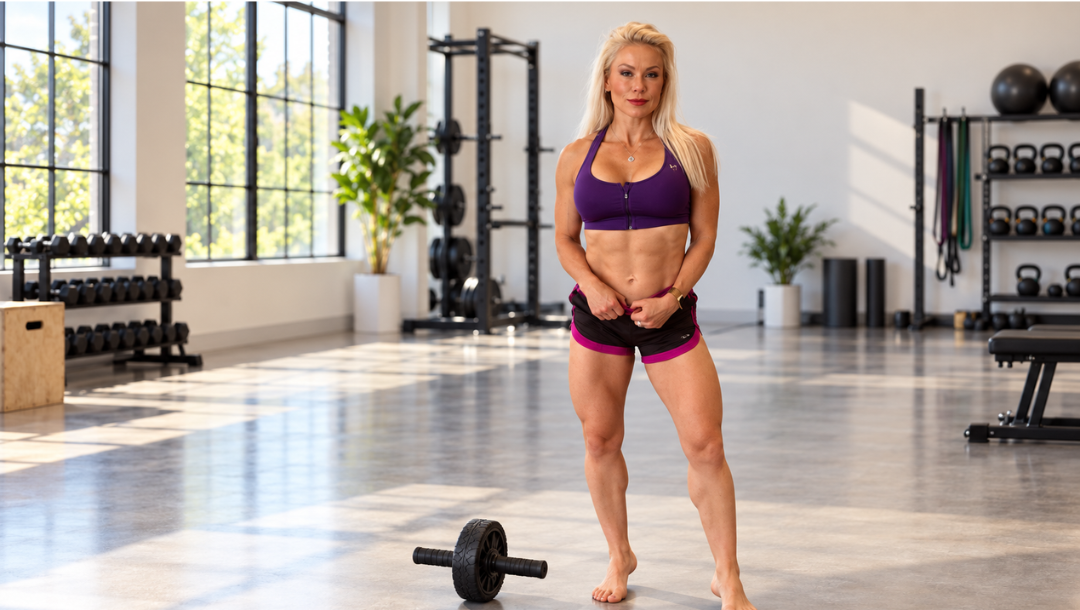
Ab exercises play a crucial role in strengthening the core muscles, which are essential for overall stability, balance, and functional movement. This guide delves into ab wheel rollouts, the muscles involved, the benefits, common mistakes associated with ab wheel rollouts, how to perform the ab wheel rollout properly, and gives you ideas to complete your ab workout.
The ab roller or ab wheel seems to be one of the best pieces of equipment to exercise your abs. So if you are going to train your abs with something besides your own body weight, this is the product to purchase. A study by the American Council on Exercise showed that ab wheel rollouts generate more muscle activity in your abs and obliques than traditional crunches.
What Muscles Do Ab Wheel Rollouts Work?
Primary Muscles:
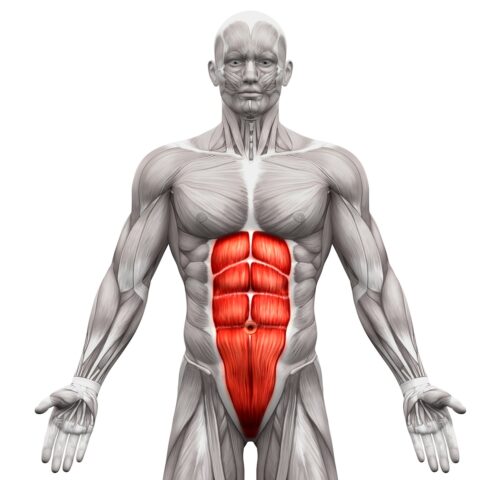
- Core Muscles: The core muscles include the rectus abdominis – the superficial muscles that create the six-pack appearance. Additionally, other muscles involved are the deeper muscles that stabilize the spine and pelvis, such as the internal and external obliques, erector spinae, transverse abdominis, pyramidalis, pelvic floor muscles, and lumbar muscles.
Secondary Muscles:
- Deltoids: These triangular muscles cover the shoulder joint and are responsible for flexing and extending the shoulder joint as well as lifting the arms to the sides, forward, and backward. They are divided into three main parts, or heads: the anterior (front) deltoid, the lateral (side) deltoid, and the posterior (rear) deltoid.
- Back Muscles: The lats and upper back are involved in the movement and play crucial roles in maintaining posture, facilitating movement, and supporting the spine. The lats (Latissimus Dorsi) are the broad muscles on the back that extend to the sides. Some of the major upper back muscles include trapezius (extending down the back of the neck and spine), rhomboids (located between the shoulder blades), levator scapulae (running along the side and back of the neck), erector spinae (located along the spine), and serratus posterior superior and inferior (running along the sides of the upper back).
Ab Wheel Rollout Benefits
Ab wheel rollout benefits are numerous:
Full Ab Engagement
Ab wheel rollouts allow for a full range of motion, engaging the entire core, including the rectus abdominis, obliques, and transverse abdominis. Consequently, your ab aesthetics will be on point. Unlike traditional crunches that primarily target superficial abdominal muscles, ab wheel rollouts challenge the deeper stabilizing muscles of the core as well. This creates greater overall abdominal activation, helping develop both visible definition and functional core strength.
Core Stability
The core muscles provide stability to the spine and pelvis, which is essential for maintaining proper posture and preventing injuries. Ab wheel rollouts are especially effective for developing anti-extension strength, meaning your core learns to resist excessive spinal arching during movement. Improved core stability can enhance balance, movement control, athletic performance, and overall body mechanics during daily activities and exercise.
Functional Strength
The ab wheel rollout is a compound exercise that not only targets the abs but also works the shoulders and back muscles. This functional strength is beneficial for overall physical performance and stamina. Because multiple muscle groups must work together simultaneously, ab wheel rollouts help improve coordination, force transfer, and total-body control. This type of integrated training carries over into sports, lifting, and everyday movement patterns.
Fat Loss
Since this exercise involves several muscle groups, you engage more muscles and lose more body fat. Compound movements generally require greater energy expenditure compared to isolated exercises, helping increase calorie burn during workouts. When combined with proper nutrition and a consistent training program, ab wheel rollouts can support overall fat loss and improved body composition.
Improved Posture
A strong core helps maintain good posture, reducing the risk of back pain and promoting overall spinal health. Ab wheel rollouts strengthen the muscles responsible for stabilizing the spine and pelvis, which can help counteract poor posture associated with prolonged sitting and inactivity. Better posture may also improve movement efficiency, breathing mechanics, and physical confidence.
Scapular and Shoulder Activation
The exercise involves protraction and retraction of the scapulae, helping to strengthen the muscles around the shoulder blades. This activation can improve shoulder stability, mobility, and control while supporting healthier movement mechanics in the upper body. Strong scapular stabilizers are especially important for athletes and individuals who perform pushing, pulling, or overhead movements regularly.
Pain and Injury Prevention
A well-developed core can help prevent injuries, especially in the lower back. It acts as a natural support system for the spine, reducing the risk of strains and other injuries. By improving spinal stability and movement control, ab wheel rollouts may help decrease excessive stress placed on the lower back during exercise and daily activities. Proper form and gradual progression are important to maximize benefits while minimizing injury risk. You can also include this move among the Best Exercises for Lower Back Pain Relief.
Functional Fitness
Ab wheel rollouts are considered a highly functional exercise because they train the body to stabilize the spine while generating movement through the shoulders and hips. Unlike isolated abdominal exercises, ab wheel rollouts require coordination between the core, shoulders, lats, and stabilizing muscles throughout the body. This improves real-world movement efficiency, posture, athletic performance, and injury resilience. By strengthening anti-extension core control, ab wheel rollouts help support safer lifting mechanics, spinal stability, and total-body strength.
Versatility
Ab wheel rollouts can be easily modified to match different fitness levels. Beginners can start from a kneeling position, engaging in a short range of motion, and gradually progress to a full rollout from the toes. More advanced individuals can incorporate standing rollouts, tempo variations, or single-arm progressions to increase difficulty and continue building strength. This versatility makes the exercise effective for a wide range of fitness levels and training goals.
Time Efficiency
Ab wheel rollouts are a time-efficient way to target multiple muscle groups simultaneously, making them a valuable addition to a comprehensive workout routine. In just a few sets, you can challenge the core, shoulders, lats, arms, and stabilizing muscles throughout the body. This makes ab wheel rollouts particularly useful for individuals seeking effective workouts without spending excessive time training.
How to Perform Wheel Rollouts
- Kneel on a mat and position the ab wheel in front of you.
- From this kneeling position, grab the handles of the ab roller tightly and lift your feet off the mat.
- Position your back in neutral alignment, contract your abdominal muscles, and squeeze your glutes.
- As you exhale, roll the wheel out in front of you as far as you can go while keeping your lower back straight!
- Pause for a second at the fully extended position and don’t lock your elbows.
- As you become stronger, you’ll be able to extend your body until it is parallel to the floor.
- As you inhale, use your abdominals to roll your body back up to the starting position.
- Repeat.
🛑 Caution: If you are pregnant, have chronic back pain, knee pain, or other injuries, avoid this exercise and consult your health provider. If you feel back pain during the movement, stop and check your form. If the pain continues, stop the exercise.
Ab Wheel Rollout Modifications for Beginners
If you are new to ab wheel rollouts, starting with beginner-friendly progressions can help you build the core strength, stability, and movement control needed to perform the exercise safely and effectively. Progressing too quickly into advanced variations, especially standing rollouts, can place excessive stress on the lower back and shoulders if your core is not yet strong enough to maintain proper alignment.
Wall Rollouts
Wall rollouts are one of the safest ways to learn the movement pattern. Instead of rolling freely across the floor, the wheel stops when it reaches a wall, limiting the range of motion and reducing strain on the core and lower back. This variation can help you practice bracing the abdominals, maintaining a neutral spine, and controlling the rollout without overextending.
Partial Range Rollouts
Partial range rollouts are another excellent progression for beginners. Rather than rolling all the way forward, you only extend as far as you can while maintaining proper form and core tension. Even a short rollout can significantly activate the abdominal muscles.
Stability Ball Rollouts
Using a stability ball instead of an ab wheel offers a more forgiving variation because the ball provides additional stability and smoother movement, placing less demand on balance and anti-extension strength.
Advanced Ab Wheel Rollout Variations
Once you have developed solid core strength and mastered proper technique, advanced ab wheel rollout variations can provide a greater challenge for the abdominals, shoulders, lats, and stabilizing muscles throughout the body. These progressions increase difficulty by adding instability, resistance, or extended leverage demands.
Standing Ab Wheel Rollouts
The standing ab wheel rollout is one of the most advanced bodyweight core exercises. Unlike the standard kneeling rollouts, standing rollouts require significantly greater anti-extension strength, shoulder stability, and full-body control.
Band-Resisted Rollouts
Band-resisted rollouts involve attaching a resistance band to the ab wheel or body to increase tension during the movement. The added resistance intensifies muscular demand throughout both the rollout and return phases, making the exercise more challenging. This variation is especially useful for athletes seeking greater strength and power development.
Tempo Rollouts
Tempo rollouts increase time under tension by slowing down different phases of the movement. For example, performing a 3–5 second eccentric rollout forces the abdominal muscles to work harder to maintain spinal stability and control. Slow-tempo training can improve core endurance and movement quality while making the exercise significantly more difficult.
Ab Wheel Rollout Mistakes
Now you know how to perform ab wheel rollouts with the correct form. Next, let’s look into the most common mistakes associated with the exercise:
- Not Engaging Your Core: Ab wheel rollouts require that you engage your core through the entire movement. Keeping your core tight helps you to avoid dropping your hips and lower back dipping.
- Using Your Back Instead of Your Core: Sometimes people pull their weight back up to the starting position using their back instead of their core. This defeats the purpose of the exercise. Even though the back muscles are involved in the movement, the prime movers are the abdominal muscles.
- Not Keeping a Neutral Spine: Rounding your back or arching it changes your alignment. This can increase your risk of lumbar strain or further injury. Maintain body alignment and keep your core tight. Roll out as far as you can, keep your body in a straight line. Proper form is crucial to avoid injury during ab wheel rollouts.
Ab Wheel Rollout Video Tutorial
Ab Workout
You can complete your ab workout by performing the following exercises:
Conclusion
Ab wheel rollout benefits are vast. Ab wheel rollouts are one of the most powerful exercises for developing core strength, spinal stability, and total-body control. Whether you’re a beginner starting with kneeling rollouts or progressing toward advanced standing variations, mastering proper form is essential for maximizing results while minimizing injury risk. With consistency and correct technique, the ab wheel can become one of the most effective tools for building a stronger, more athletic body.
👉🏻 If you’re struggling to see results, stay consistent, or create effective routines, don’t do it alone. A personalized program can offer the guidance, support, and accountability you need to reach your goals faster and with greater confidence. Reach out today—you’re closer than you think!
Frequently Asked Questions
Ab wheel rollouts are often considered more effective than traditional crunches because they challenge the core through anti-extension stability rather than repetitive spinal flexion. While crunches primarily target the rectus abdominis, ab wheel rollouts engage multiple muscle groups simultaneously, including the transverse abdominis, obliques, shoulders, lats, and spinal stabilizers. This makes ab wheel rollouts a more functional, full-body core exercise that can improve strength, stability, posture, and athletic performance.
Yes, ab wheel rollouts can help build stronger and more defined abdominal muscles. The exercise creates significant tension throughout the core, particularly in the rectus abdominis and deep stabilizing muscles. However, visible abs also depend heavily on overall body fat levels, nutrition, and consistent training. Ab wheel rollouts are highly effective for strengthening and developing the core when combined with a balanced fitness and nutrition plan.
Ab wheel rollouts can be safe for beginners when proper progressions and technique are used. Starting with beginner-friendly variations such as wall rollouts, stability ball rollouts, or partial range kneeling rollouts can help develop the necessary core strength and control. Beginners should focus on maintaining a neutral spine, bracing the core, and avoiding excessive lower back arching during the movement.
The ideal number of ab wheel rollouts depends on your fitness level and core strength. Beginners may start with 2–3 sets of 5–8 controlled repetitions, while more advanced individuals can perform 10–15 repetitions or incorporate advanced variations. Quality and control are more important than high repetition counts. Performing the movement slowly with proper form helps maximize core activation and reduce injury risk.
Ab wheel rollouts can place stress on the lower back if performed with poor form or insufficient core strength. Allowing the hips to sag or the lower back to arch excessively may increase spinal strain. However, when performed correctly with proper core bracing and controlled movement, ab wheel rollouts can actually help strengthen the muscles that support spinal stability and posture. Beginners should progress gradually and avoid extending beyond their current strength capacity.
Yes, ab wheel rollouts strongly activate the lower portion of the rectus abdominis along with the deeper core stabilizers. Although the abdominal muscles function as one integrated unit, many people feel significant activation in the lower abdominal region during rollouts because the exercise requires intense stabilization and pelvic control. The movement also challenges the transverse abdominis and obliques, making it an effective exercise for total core development.
To a Fitter Healthier You,
Mind-Body Optimization Specialist
About the Author
Adriana Albritton is a Mind-Body Optimization Specialist and founder of FitnAll Coaching. She developed the FITNALL Method, a holistic framework that integrates fitness, internal health, thought patterns, nutrition, adaptation, longevity, and lifestyle habits to support sustainable fat loss and long-term wellness. Adriana is the author of 28 Days to a New Life: A Holistic Program to Get Fit, Delay Aging, and Enhance Your Mindset. She speaks and writes about holistic performance, longevity, and the integration of mind and body for optimal health.